Visita nuestras redes
2026-03-21
Estamos activos en Facebook e Instagram. Revisa nuestras publicaciones y síguenos.
Read more about Visita nuestras redes
Estamos activos en Facebook e Instagram. Revisa nuestras publicaciones y síguenos.
Read more about Visita nuestras redes
Contemporary education faces challenges that require new ways to understand, support, and transform educational processes. In this context, Volume 2, Issue 3 of INNOVACADEMIA brings together five research articles, one review article, and two essays that, from diverse perspectives, address topics related to comprehensive education, educational innovation, artificial intelligence, and learning experiences connected to current needs.
Among the research studies, one examines the role of the Institutional Tutoring Program as a strategy to promote student retention, graduation efficiency, and degree completion, highlighting the importance of continuous and targeted support throughout students’ university trajectories. Artificial intelligence is another central theme of this issue. One study analyzes the use of generative artificial intelligence chatbots in the development of research protocols and their effects on academic writing.
The development of critical thinking also occupies a prominent place. Based on an analysis of the perceptions of Psychology students and faculty members, the study identifies differences in their experiences and some of the challenges involved in teaching aimed at strengthening this essential competency for professional education.
Comprehensive education is also addressed from an artistic perspective. One study draws on the experiences of members of a university folk dance group and shows how artistic practice can contribute to students’ socioemotional development and enrich their education beyond the academic sphere.
Another study examines the knowledge, use, and challenges associated with artificial intelligence in the professional practice of upper secondary education teachers, providing insights for reflecting on the opportunities and challenges posed by this technology in the educational context.
From an interdisciplinary perspective, the review article addresses behavioral management strategies in the dental care of pediatric patients with ADHD, aimed at promoting cooperation and reducing anxiety during dental appointments. This work highlights the importance of considering patients’ particular characteristics and needs in care processes and in the education of health professionals.
Finally, two essays expand the reflection on university education and professional development. The first addresses teacher professional development as an ongoing process for strengthening educational practice; the second reflects on international collaboration in graduate education and the value of academic mobility, co-supervision, co-authorship, and language proficiency in researcher training.
Taken together, the works featured in this issue offer diverse perspectives on the challenges and opportunities facing contemporary education and invite reflection on the need to build innovative, comprehensive educational experiences that are connected to the needs of the surrounding environment.
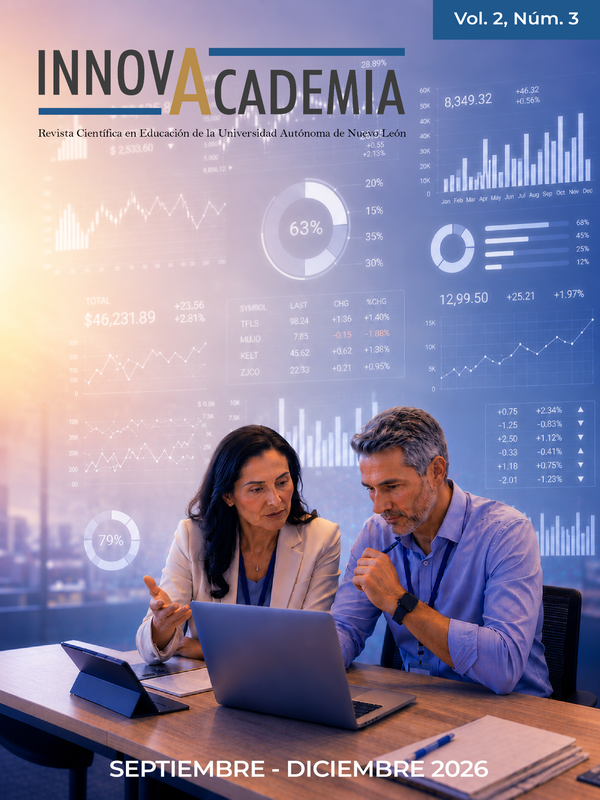
INOVACADEMIA, Vol. 2 Núm. 3, septiembre - diciembre 2026, es una revista en open access con periodicidad cuatrimestral, editada y publicadapor la Universidad Autónoma de Nuevo León a través de la Secretaría Académica. Domicilio de la publicación: Ave Universidad s/n, cd.Universitaria, San Nicolás de los Garza, Nuevo León, México, C.P. 66455. Teléfono +52 8183-29-4000. Correo electrónico:innovacademia@uanl.mx. Dirección web: https://innovacademia.uanl.mx/. Editora responsable: Dra. Jessica Mariela Rodríguez Hernández. Responsable de esta edición: Dra. Jessica Mariela Rodríguez Hernández. Reserva de Derechos al uso Exclusivo: 04-2024-08141102100-102. ISSN 3061-7952, ambos otorgados por el Instituto Nacional del Derecho de Autor. Fecha de última modificación, 30 de septiembre de 2026. Las opiniones expresadas por los autores no necesariamente reflejan la visión de la publicación.La portada de este número fue creada con apoyo de inteligencia artificial a través de la herramienta ChatGPT y curaduría editorial.


INNOVACADEMIA, Scientific Journal of Education of Universidad Autónoma de Nuevo León, is an open access journal published every four months by Universidad Autónoma de Nuevo León through its Secretaría Académica. Publication address: Ave Universidad s/n, Ciudad Universitaria, San Nicolás de los Garza, Nuevo León, Mexico, C.P. 66455. Phone: +52 8183-29-4000. Editor: Dr. Jessica Mariela Rodríguez Hernández. Reservation of Exclusive Usage Rights 04-2024-081411002100-102, ISSN pending, both granted by the National Institute of Copyright. The opinions expressed by the authors do not necessarily reflect the views of the journal.
This journal and its articles are published under the Creative Commons Attribution-NonCommercial-ShareAlike 4.0 International License (CC BY-NC-SA 4.0), which allows users to freely use, share, and adapt the content of INNOVACADEMIA, provided that credit is given, it is not used for commercial purposes, and any derivative material is shared under the same license.